
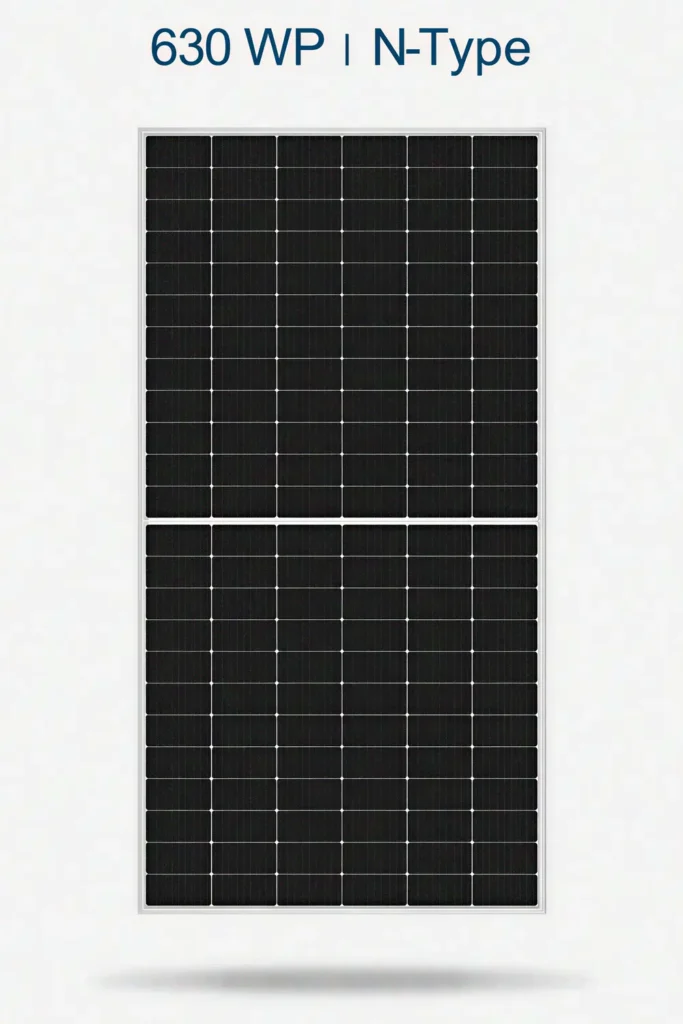
Higher wattage solar panels have become the default for Malaysian residential upgrades. Where earlier systems used 300W and 400W panels, most Solar ATAP applications in 2026 now specify 500W and above. If you’re evaluating a home system and comparing quotes, understanding what each high-wattage tier can actually power on a Malaysian rooftop helps you match the panel size to your household consumption.
This guide focuses on residential capability. For lower-wattage and portable setups, see our guide on what 100W to 400W solar panels can power.
What is a high-wattage solar panel?
High-wattage panels sit in the 500W to 600W+ range, built using newer cell technologies like TOPCon, HJT, and bifacial construction that push more output out of the same panel footprint. The practical benefit for a Malaysian home is fewer panels for the same target system size. A 5kW system needs 10 × 500W panels, versus 13 × 400W panels — less mounting hardware, faster installation, and more usable roof area preserved. High-wattage panels are also the newer inventory installers stock, which usually means better warranties and higher efficiency ratings.
What can a 500W solar panel power?
A single 500W panel in Malaysian conditions produces roughly 1.7 kWh per day (about 51 kWh per month), based on 4.5 peak sun hours and typical system losses.
Practically, one panel’s daily output covers a household fridge (~1.2 kWh per day), runs LED lights across a whole home for 12 to 15 hours, or powers a ceiling fan continuously for around 20 hours.
In a real residential system, you’d install 10 to 12 of these panels — a 5 to 6kW system producing 17 to 20 kWh per day. That’s enough to offset most of a typical double storey terrace’s daytime consumption, with surplus exported under Solar ATAP or stored in a BESS for evening use.
What can a 550W solar panel power?
The current sweet spot for Malaysian residential installs. A single 550W panel produces about 1.9 kWh per day (~56 kWh per month) under typical Klang Valley conditions.
Where 550W panels shine is high-load home usage. A 6 to 8kW system built from 12 to 15 × 550W panels can handle one or two aircon units running through the day (each unit uses 1 to 1.5 kWh per hour), fridge, TV, washing machine, and standard household loads, plus slow EV charging during daylight (a typical EV needs 8 to 15 kWh for daily commute charging).
Paired with a 5 to 10 kWh BESS, this same system extends solar-powered aircon and lighting into the evening, cutting your reliance on TNB grid supply after sunset.
What can a 600W+ solar panel power?
The upper end of what still makes sense residentially. A single 600W panel produces around 2.0 kWh per day (~61 kWh per month). Systems built with 600W+ panels typically target larger properties — semi-D homes, bungalows, or households running combined high-load setups like EV charging plus multiple aircon units.
A 10kW system built from 16 to 17 × 600W panels can realistically cover the daytime load of a large family home with three to four aircon units, EV charging, pool pumps, and a full appliance stack. This is also the wattage tier where residential begins to overlap with small commercial — a shoplot or SME with similar consumption patterns could use the same panel spec under Solar ATAP’s non-domestic terms.
For most Malaysian homes, 550W remains the practical ceiling. 600W+ is worth considering if roof space is limited, your consumption is genuinely high, or you’re planning to add BESS and EV charging in the same install.
Comparison at a glance
| Panel Wattage | Realistic Daily Output (MY) | Monthly Output | Best Residential Fit |
| 500W | 1.7 kWh | ~51 kWh | Terrace, 4 to 6kW system |
| 550W | 1.9 kWh | ~56 kWh | Terrace to semi-D, 6 to 8kW system |
| 600W+ | 2.0 kWh | ~61 kWh | Semi-D, bungalow, 8 to 10kW+ system |
Which high-wattage panel is right for you?
The right choice depends on four things: available roof area, monthly electricity consumption, whether you’re planning battery storage or EV charging, and your budget. If your roof has generous space and your consumption is standard residential (RM200 to RM400 monthly TNB bill), 500W to 550W is typically the best value. If roof space is tighter or your consumption runs higher (RM500+ monthly, EV, or heavy aircon usage), 600W+ starts to make sense.
For a proper sizing recommendation, a site assessment from a SEDA Registered PV Service Provider (RPVSP) will match the panel wattage to your specific roof and usage profile. Read our Residential Solar System page for the full breakdown, or request quotes from verified installers.
Frequently asked questions
How many 500W panels do I need for a typical Malaysian home?
Most double storey terrace households need 10 to 14 × 500W panels for a 5 to 7kW system, sized to cover roughly 70 to 80% of daytime consumption. Exact numbers depend on your monthly TNB usage and available roof area.
Are 600W+ panels overkill for residential use?
Not necessarily. If you have a large home, high consumption, or plan to add EV charging and BESS, 600W+ panels reduce panel count for the same total capacity. For standard terrace homes, 500W to 550W is usually more cost effective per watt installed.
Can high-wattage panels work with battery storage under Solar ATAP?
Yes. Solar ATAP prioritises self-consumption first, then export of surplus at prevailing tariff rates. Pairing high-wattage panels with a BESS lets you use more of your generation directly and export less, which typically improves your bill savings compared to export-only setups.
Ready to size a high-wattage system for your home?
Solar Plus connects Malaysian homeowners with SEDA Registered PV Service Providers (RPVSPs) for Solar ATAP applications. Whether you’re comparing 500W, 550W, or 600W+ panels, the fastest way to work out what fits your roof and budget is a formal quote from a verified installer.
Use our Solar Calculator to estimate system size, or request quotes. For a deeper look at the specs themselves, see Solar Panel Wattage, Output & Efficiency Explained.