
Two questions matter before you install solar in Malaysia: how large should your system be, and how much could you save?
Install too small a system and you may miss potential savings. Install too large a system and you may pay for generation that does not provide equal financial value.
This guide explains three common solar sizing methods used across Peninsular Malaysia, from a quick bill-based estimate to a more detailed step-by-step calculation. Together, these methods can help you establish a reasonable system-size range before speaking to an installer.
Method 1 — Sizing Your Solar System by Your TNB Bill
The fastest way to estimate a residential solar system size is to work backwards from your monthly TNB bill.
In Peninsular Malaysia, each installed kilowatt of solar may generate roughly 110 kWh per month under typical conditions. However, the recommended system size cannot be calculated from generation alone because actual savings depend on your electricity usage pattern, applicable TNB charges and how much solar energy you use directly.
As a quick planning estimate, the following rule of thumb may be used:
Estimated system size (kW) ≈ Monthly TNB bill ÷ 75
This is an initial estimate only. The final system size should be confirmed using your actual electricity consumption, daytime usage, available roof space and applicable Solar ATAP requirements.
Worked examples:
- RM300 bill → 300 ÷ 75 = 4 kW system
- RM500 bill → 500 ÷ 75 ≈ 6 to 7 kW system
- RM800 bill → 800 ÷ 75 ≈ 10 to 11 kW system
- RM1,200 bill → 1,200 ÷ 75 = 15 to 16 kW system
Quick reference table:
| Monthly TNB Bill | Estimated System Size | Panels at 450W | Estimated Monthly Savings | Estimated Payback |
| RM200 to RM350 | 3 to 4 kW | 7 to 9 | RM150 to RM220 | 6 to 8 years |
| RM350 to RM650 | 5 to 6 kW | 11 to 14 | RM250 to RM350 | 5 to 7 years |
| RM650 to RM1,000 | 8 to 10 kW | 18 to 22 | RM400 to RM550 | 5 to 6 years |
| RM1,000 to RM1,500 | 12 to 15 kW | 27 to 33 | RM600 to RM800 | 4 to 6 years |
These figures are illustrative and may vary depending on electricity usage, roof conditions, tariff structure, system design and applicable capacity limits.
For a faster estimate, use our solar calculator Malaysia to calculate a recommended system size based on your bill amount.
Method 2 — Sizing Your Solar System by Roof Space
If your goal is to maximise rooftop generation rather than only offset your current electricity bill, start with your available roof area.
A typical solar panel measures approximately 2.1 metres by 1.1 metres and produces between 450W and 550W. After allowing for access, spacing, roof edges and other installation requirements, one kilowatt of solar may require roughly 5.5 to 7 square metres of usable roof space.
Panel dimensions and power ratings vary between models. Read our guide to solar panel wattage and efficiency to understand how panel output affects system size and roof-space requirements.
The rule of thumb:
Maximum system size (kW) ≈ Usable roof area (m²) ÷ 6.5
Quick reference table:
| Usable Roof Area | Estimated Maximum System Size | Typical Property Type |
| 20 to 30 m² | 3 to 4 kW | Terrace house |
| 40 to 55 m² | 6 to 8 kW | Semi-detached house |
| 65 to 90 m² | 10 to 13 kW | Bungalow |
| 100 m² and above | 15 kW and above | Large bungalow or commercial property |
Roof-space factors to consider
Remember to deduct space occupied by:
- Water tanks
- Air-conditioning compressors
- Skylights
- Roof access areas
- Shaded sections
- Required edge setbacks
Many homeowners overestimate their usable roof area because the full roof surface may not be suitable for solar panels.
Combining the Bill and Roof-Space Methods
Compare the result from your electricity bill with the maximum capacity your roof can support.
For example, if your bill suggests a 10 kW system but your roof can only accommodate 8 kW, the practical system size may be closer to 8 kW.
The final recommendation should also consider your electrical supply, usage pattern and applicable programme requirements.
Method 3 — Step-by-Step Solar Sizing Calculation
For a more detailed estimate, calculate your system size using actual electricity consumption rather than relying only on bill-based shortcuts.
This five-step method reflects the general process used to estimate solar array capacity.
Step 1: Find Your Monthly Electricity Consumption
Check the monthly kWh figure shown on your TNB bill.
Where the kWh figure is unavailable, you may estimate it using an assumed blended tariff.
For example:
RM500 ÷ RM0.55 ≈ 900 kWh per month
This remains an approximation because the effective tariff may vary depending on your consumption and bill structure.
Step 2: Convert Monthly Usage to Daily Usage
Daily electricity usage = Monthly kWh ÷ 30
Example:
900 ÷ 30 = 30 kWh per day
Step 3: Divide by Malaysian Peak Sun Hours
Peninsular Malaysia receives approximately 4.5 peak sun hours per day under typical conditions.
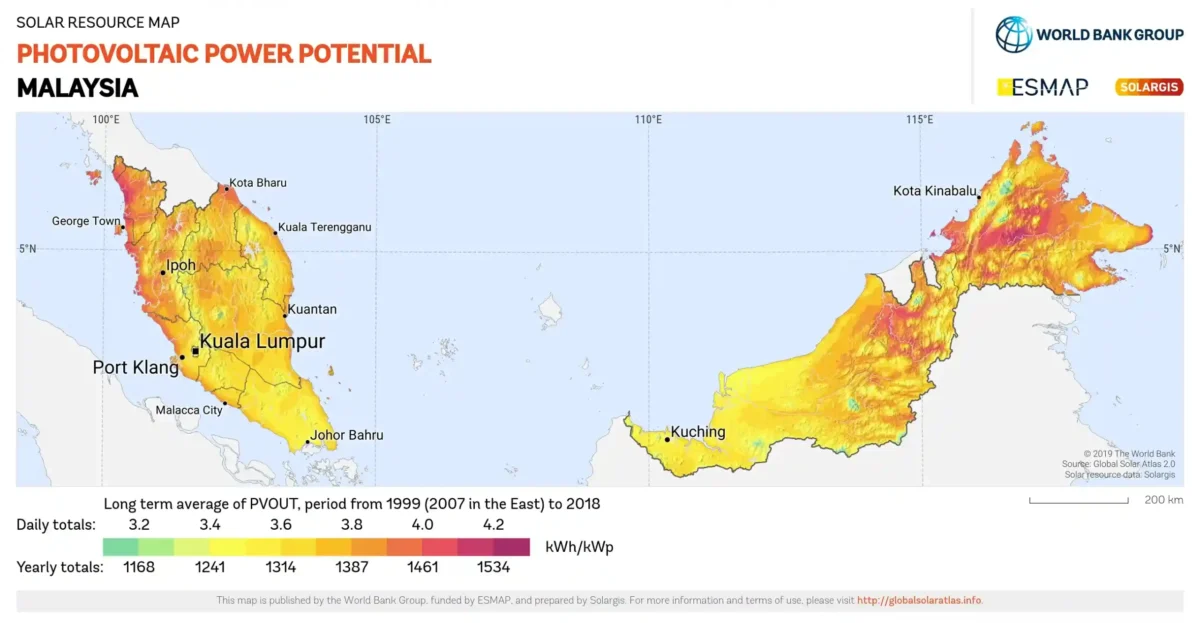
Peak sun hours refer to the equivalent number of hours during which solar irradiance averages 1,000 watts per square metre. It does not mean that sunlight is available for only 4.5 hours.
Base array size (kW) = Daily kWh ÷ Peak sun hours
Example:
30 ÷ 4.5 ≈ 6.7 kW
Step 4: Allow for Real-World System Losses
Actual solar output may be affected by:
- High temperatures
- Dust and dirt
- Wiring losses
- Inverter conversion losses
- Shading
- Panel ageing
A planning allowance may be added to account for these factors.
Adjusted array size = Base array size × 1.2
Example:
6.7 × 1.2 ≈ 8 kW
Step 5: Convert System Size to Panel Count
For an 8 kW system using 450W panels:
8,000W ÷ 450W ≈ 18 panels
The final panel count depends on the wattage of each panel. Higher-wattage panels may reduce the number required, especially when roof space is limited. Read our guide to solar panel wattage, output and efficiency for more details.
For a household using around 900 kWh per month, this method suggests an estimated 8 kW system with approximately 18 panels. This is higher than the bill-based estimate because the detailed method includes system losses and aims to offset a larger share of electricity usage.
The final system size should still be based on daytime usage, roof suitability, budget and applicable capacity requirements.
How to Estimate Your Monthly Solar Savings
Once you have an estimated system size, you can calculate potential savings using a simple planning formula.
Estimated monthly savings = System size × Estimated monthly generation × Electricity value
Using an estimated monthly generation of 110 kWh per installed kW and an assumed electricity value of RM0.55 per kWh:
Estimated monthly savings = System size (kW) × 110 kWh × RM0.55
Worked examples:
- 4 kW system: 4 × 110 × RM0.55 = RM242 per month, or approximately RM2,900 per year
- 6 kW system: 6 × 110 × RM0.55 = RM363 per month, or approximately RM4,360 per year
- 10 kW system: 10 × 110 × RM0.55 = RM605 per month, or approximately RM7,260 per year
These estimates assume that the generated electricity provides the stated value. Actual savings will depend on how much solar energy is used directly, how much is exported, your applicable electricity charges and the programme rules in place.
Estimating the Payback Period
Estimated payback period = Total system cost ÷ Estimated annual savings
If a 6 kW system costs approximately RM21,000 to RM27,000 and generates estimated annual savings of RM4,360, the simple payback period may be around 5 to 6 years.
This is an illustrative estimate only. Actual installation pricing may vary depending on:
- Panel and inverter specifications
- Roof structure
- Installation complexity
- Electrical upgrading requirements
- Monitoring equipment
- Approval and metering requirements
- Warranty coverage
- After-sales support
For a personalised estimate based on your bill and property type, use our free solar calculator.
Common Solar Sizing Mistakes to Avoid in Malaysia
Oversizing Beyond Your Usable Consumption
A larger system does not always deliver proportionately higher financial returns.
Under Solar ATAP, exported electricity may offset eligible electricity charges within the same billing period, subject to the applicable programme terms. Unused excess may not provide the same value as electricity consumed directly.
Your system should therefore be sized around your consumption profile, roof capacity and applicable programme limits.
Undersizing Only to Reduce the Upfront Cost
A smaller system may lower the initial investment, but it can also limit your long-term savings.
Expanding a solar system later may involve additional equipment, labour, approval and compatibility considerations. It is therefore better to assess your current and future needs before installation.
Ignoring Future Electricity Usage
Consider whether your electricity demand may increase in the coming years.
For example, you may plan to:
- Purchase an electric vehicle
- Add more air-conditioning units
- Install a water heater
- Extend the property
- Increase home-based working
- Add new electrical equipment
A system that meets your needs today may become undersized if your electricity consumption rises significantly.
Skipping a Shading Assessment
Trees, neighbouring buildings, water tanks and other roof structures can reduce solar output.
The impact depends on the size, location and timing of the shade. A proper site assessment can help determine the most suitable panel placement and system design.
Treating Total Roof Area as Usable Roof Area
Not every part of the roof can be covered with solar panels.
Space may be required for access, safety, maintenance, setbacks, roof obstructions and unsuitable shaded areas. Always calculate based on usable roof space rather than total roof size.
Factors That Affect Your Actual Solar Output
The sizing figures in this guide are based on general assumptions. Your actual solar generation may vary according to several factors.
Self-Consumption Rate
Solar electricity used directly by your household may provide different financial value from exported electricity.
The more closely solar generation matches your daytime usage, the more effectively the system may offset electricity purchased from the grid.
Roof Orientation and Design
Malaysia is located close to the equator, so solar performance should not be judged using orientation rules from countries with very different climates.
Roof pitch, shading, panel orientation and your household’s electricity-use pattern should be assessed together.
Weather and Shading
Cloud cover, haze, heavy rain, dirt and surrounding obstacles can reduce solar generation.
Output will also vary throughout the year.
Panel Degradation
Solar panels gradually lose a small amount of output over time.
Understanding solar panel wattage and efficiency can help you set more realistic long-term expectations.
Solar ATAP Capacity Requirements
The system size you can install may depend on your meter type, electrical supply, premises category and technical assessment.
A bill-based or roof-based calculation may suggest a certain capacity, but the final approved system size must comply with the applicable Solar ATAP requirements.
Frequently Asked Questions
How Many Solar Panels Do I Need for a Malaysian Home?
Many Malaysian homes may require between 8 and 22 panels, depending on electricity consumption, roof capacity and the wattage of each panel.
For example:
- A RM500 monthly bill may suggest approximately 12 to 14 panels for a 6 kW system
- A RM800 monthly bill may suggest approximately 18 to 22 panels for a 9 to 10 kW system
These are planning estimates based on panels rated between 450W and 550W.
What Size Solar System Do I Need for a RM500 Monthly Bill?
A quick bill-based estimate suggests a system of approximately 6 to 7 kW.
However, a more detailed calculation based on monthly kWh consumption, peak sun hours and system losses may produce a higher estimate.
The suitable system size depends on:
- Daytime electricity consumption
- Available roof space
- Electrical supply
- Budget
- Solar ATAP requirements
How Do I Calculate Solar Panels Based on Roof Size?
Divide your usable roof area in square metres by approximately 6.5 to estimate the maximum system capacity in kilowatts.
Then divide the total required wattage by the wattage of each panel.
Example:
50 m² ÷ 6.5 ≈ 7.7 kW
Using 450W panels:
7,700W ÷ 450W ≈ 17 panels
Remember to deduct areas affected by water tanks, air-conditioning compressors, access requirements, setbacks and shading.
Ready to Check Your Numbers?
The three methods above can help you establish a practical solar sizing range.
For a more personalised estimate based on your electricity bill, property type and roof conditions, use our free solar calculator Malaysia.
It combines bill-based, electricity-consumption and roof-space considerations into one quick estimate.