
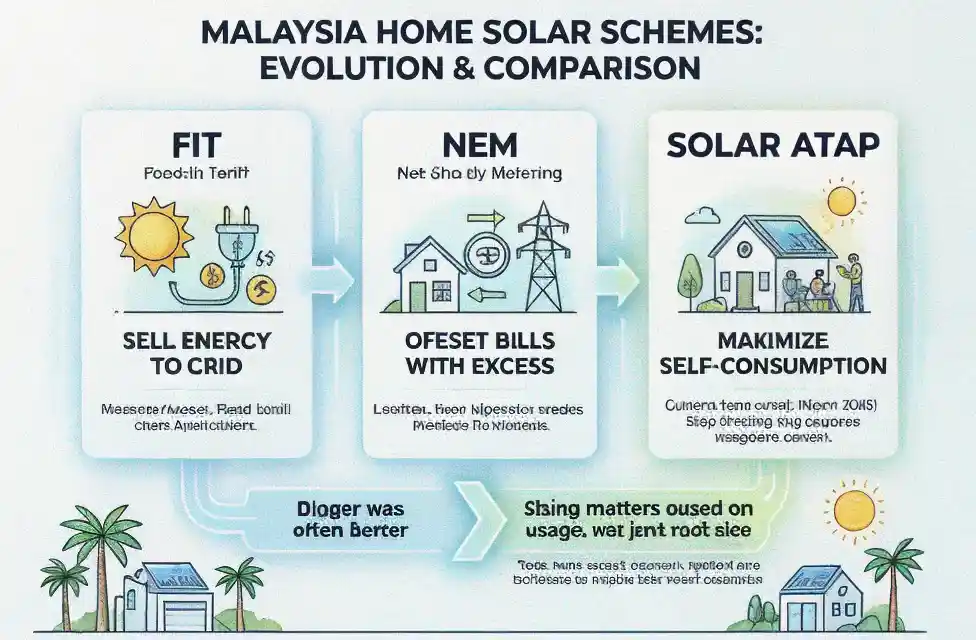
Malaysia’s rooftop solar landscape has changed over the years. Homeowners may still hear terms like FiT, NEM and Solar ATAP when researching solar panels, but these schemes do not work the same way.
This guide explains the difference between Solar ATAP, NEM and FiT, and what the shift means for Malaysian homeowners planning to install rooftop solar in 2026.
Key Takeaways
FiT, NEM and Solar ATAP are different solar frameworks, so homeowners should not compare solar packages using old assumptions.
FiT was mainly an energy-selling model, while NEM focused on electricity bill offset. Solar ATAP is the current framework from 2026, with stronger focus on self-consumption and proper system sizing.
For homeowners, the biggest change is that system size and daytime electricity usage matter more. A bigger solar system is not automatically better if the home cannot use enough of the solar energy generated during the day.
SuRIA Home is not the same as Solar ATAP. Solar ATAP is the rooftop solar framework, while SuRIA Home is a rebate programme for eligible domestic Solar ATAP customers.
Homeowners planning solar in 2026 should focus on current Solar ATAP rules, not old NEM assumptions or speculation about NEM 4.0.
Why Compare Solar ATAP, NEM and FiT?
Many homeowners still understand solar using older information from FiT or NEM. This can create confusion when comparing solar packages today.
The way solar energy is used, exported and credited has changed across different schemes. Because of this, homeowners should not rely only on old assumptions when deciding on system size, savings and payback period.
The main question is no longer just how many solar panels can fit on the roof. Homeowners should also ask how much solar energy their home can actually use well under the current Solar ATAP framework.
Malaysia’s Home Solar Policy: From FiT to NEM and Solar ATAP
Malaysia’s home solar policy has moved through different stages.
FiT was the earlier energy-selling model. Approved participants could sell renewable electricity to the grid at a fixed tariff.
NEM was the electricity-offset model. Homeowners could use solar energy for their own property and export excess electricity to offset their bill.
Solar ATAP is the current rooftop solar framework from 1 January 2026. It places stronger focus on self-consumption, proper system sizing and understanding how excess solar energy is treated under the latest rules.
What Was the Feed-in Tariff (FiT) ?
The Feed-in Tariff, or FiT, was an earlier renewable energy mechanism in Malaysia. Under FiT, approved participants could sell renewable electricity to the grid at a fixed tariff for a set period.
For most residential rooftop solar discussions today, FiT is no longer the main route homeowners should use as their reference. It is useful to understand FiT as part of Malaysia’s solar history, but homeowners planning new rooftop solar should focus on the current Solar ATAP framework.
What Was Net Energy Metering (NEM) ?
Net Energy Metering, or NEM, was introduced after FiT as a different way for homeowners and businesses to benefit from solar.
Under NEM, solar energy was first used by the property. Any excess energy could be exported to the grid and used to offset the electricity bill, subject to the scheme’s terms.
NEM 3.0 is no longer the current framework for new rooftop solar applications. This is why homeowners should be careful when reading old articles, watching old videos or comparing solar packages that still rely heavily on NEM-style assumptions.
What Is Solar ATAP?
Solar ATAP is Malaysia’s current rooftop solar framework from 2026.
Compared with older schemes, Solar ATAP puts more attention on self-consumption. This means the value of a solar system depends strongly on how much solar energy the home can use during the day.
For homeowners, this makes system sizing more important. A larger solar system is not automatically better if the household cannot use enough of the generated electricity at the right time.
Solar ATAP vs NEM: What Is the Main Difference?
The main difference is how homeowners should think about solar value.
Under NEM, many homeowners focused on exporting excess electricity and using credits to offset their bill.
Under Solar ATAP, homeowners need to focus more on using their own solar energy directly. Daytime electricity usage, system size and household consumption pattern become more important when planning a solar system.
In simple terms, NEM was more about offsetting electricity. Solar ATAP is more about self-consumption first.
FiT vs NEM vs Solar ATAP Comparison Table
| Scheme | Main Idea | Status For New Homeowners | What Homeowners Should Know |
| FiT | Sell renewable electricity to the grid at a fixed tariff | Not the main route for new residential rooftop solar | Useful as historical context, but not the main scheme to plan around today |
| NEM | Use solar first and export excess energy for bill offset | No longer the current framework for new applications | Old NEM assumptions may not apply to new solar planning |
| Solar ATAP | Use your own solar energy first under the current rooftop solar framework | Current framework from 2026 | System size and daytime usage matter more |
Is Solar ATAP The Same As SuRIA Home?
No. Solar ATAP and SuRIA Home are related, but they are not the same thing.
Solar ATAP is the current rooftop solar framework. It explains how homeowners install solar, use their own generated electricity and export excess energy under the latest rules.
SuRIA Home is a rebate programme for eligible domestic Solar ATAP customers. It offers a one-time cash rebate of RM600 per kWac, capped at RM3,000, subject to eligibility, deadline and allocation availability.
In simple terms, Solar ATAP is the solar framework. SuRIA Home is the rebate support for eligible homeowners under that framework.
What Changed For Homeowners Under Solar ATAP?
The biggest change is the way homeowners should plan their solar system.
Under Solar ATAP, homeowners should be more careful with system sizing. Instead of asking only how big the system can be, they should ask how much electricity the home actually uses during solar generation hours.
This matters because solar panels produce electricity mainly during the day. If the home has low daytime usage, a very large system may not always deliver the best value.
Homeowners should also check how excess energy is treated under the latest Solar ATAP terms, instead of assuming it works the same way as NEM.
Why Bigger Solar Systems Are Not Always Better Now
A bigger solar system may generate more electricity, but that does not automatically mean better savings.
Under Solar ATAP, the better question is whether the system size matches the household’s actual electricity usage. A suitable system should consider the TNB bill, daytime consumption, roof condition, panel output and payback assumptions.
For example, a household that uses more electricity during the day may benefit differently from a household where most energy use happens at night.
This is why homeowners should compare solar proposals carefully and avoid choosing a system only because it is the largest option.
What Should Homeowners Ask Before Installing Solar?
Before signing a solar package, homeowners should ask:
How much electricity does my home use during the day?
What system size matches my actual usage?
How is excess solar energy treated under the latest Solar ATAP terms?
Is the proposal based on current Solar ATAP rules or old NEM assumptions?
How does the system size affect my estimated savings and payback period?
Do I qualify for the SuRIA Home rebate?
Is battery storage necessary for my usage, or would it increase cost without enough benefit?
These questions help homeowners compare solar packages more carefully and avoid planning based only on old policy assumptions.
Estimate Your Solar Savings Before Comparing Packages
Understanding the difference between Solar ATAP, NEM and FiT is only the first step. Before comparing solar packages, homeowners should also estimate whether the system size matches their electricity usage.
You can use our solar calculator to get a simple estimate based on your monthly electricity bill, expected system size and potential savings.
This can help you ask better questions when speaking with a solar provider and avoid choosing a system based only on roof space or old NEM assumptions.
What Happened To NEM 4.0?
Before Solar ATAP became the current framework, some homeowners and solar providers discussed whether Malaysia would move from NEM 3.0 to a future NEM 4.0.
For new rooftop solar planning in 2026, homeowners should focus on Solar ATAP instead of waiting for another NEM version. The important question is not whether NEM will return, but how to plan solar properly under the current Solar ATAP rules.
Final Thoughts
Solar ATAP does not mean rooftop solar is no longer useful in Malaysia. It means homeowners need to plan solar differently from the old FiT or NEM era.
Instead of focusing only on the biggest system size, homeowners should understand their electricity usage, daytime consumption, roof condition and current Solar ATAP rules.
By understanding how FiT, NEM and Solar ATAP differ, homeowners can compare solar packages more carefully and make better decisions before installing rooftop solar.